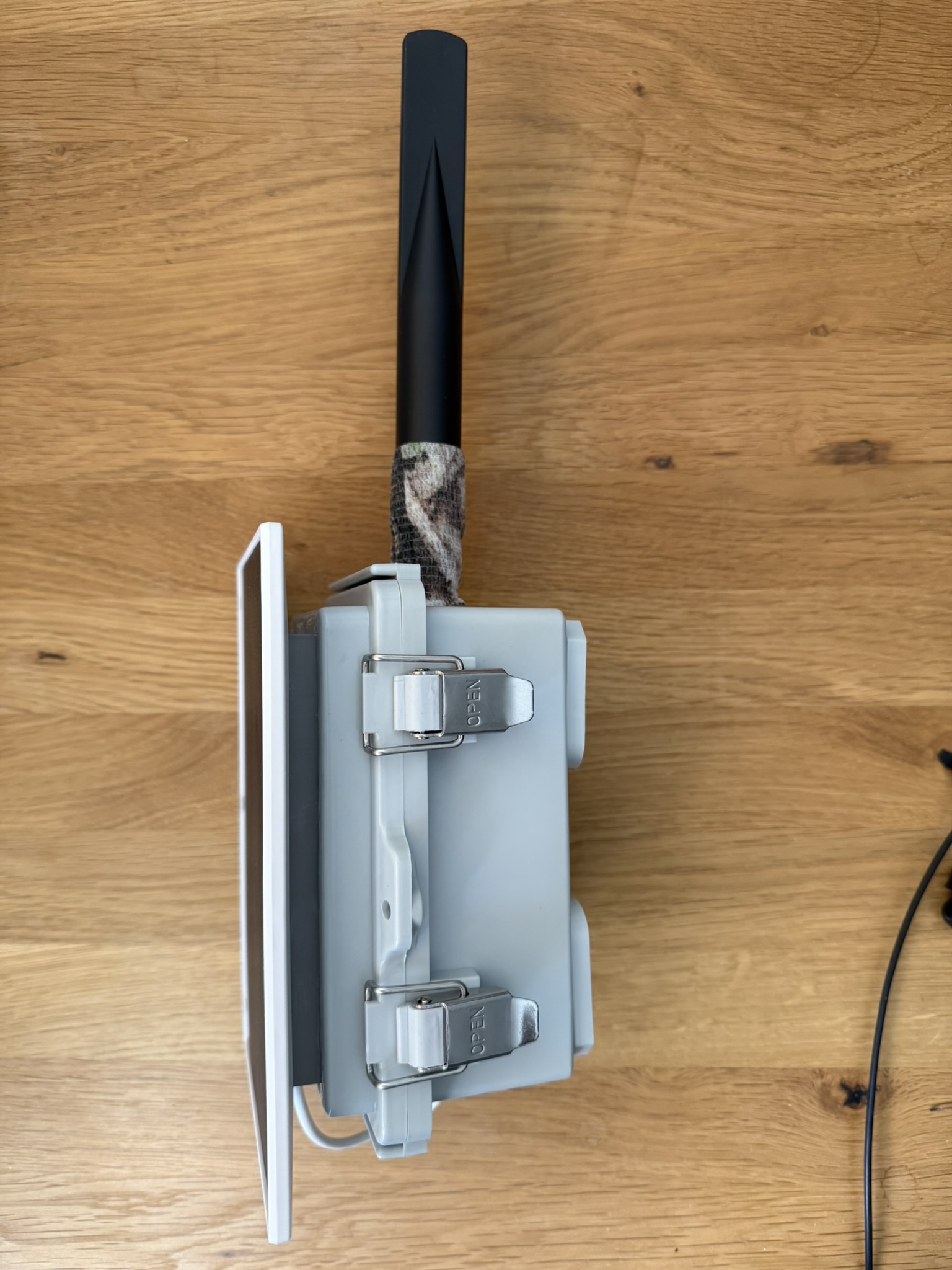
Overview
This post documents the hardware build of my solar-powered standalone MeshCore repeater. The design prioritises low power consumption, clean RF performance, and weather resistance — running completely unattended on a 10 W solar panel and a single protected 18650 cell.
Credits
A big thank you to a fellow member Thoren of the MeshCore Rheinland group, who came up with the original idea and pointed me towards exactly the right components. Without that nudge this build would still be on a whiteboard.
Hardware
Mainboard: RAK 19007 + RAK 4631
The core of the build is a two-piece WisBlock stack: the RAK 19007 base board and the RAK 4631 core module.
RAK 19007 – WisBlock Base Board
The RAK 19007 is a compact (30 × 60 mm) WisBlock carrier that takes care of power management so the core module doesn’t have to:
- Integrated LiPo/Li-Ion charge controller — no external TP4056 module needed
- Solar input via JST 1.25mm 2-pin connector wired directly to the charge controller, bypassing the USB negotiation layer entirely
- USB-C port for programming and debugging
- WisBlock slot system: expandable with GPS, additional sensors, or a second radio
RAK 4631 – WisBlock Core Module
The RAK 4631 combines a Nordic nRF52840 microcontroller with a Semtech SX1262 LoRa transceiver on a single stamp-sized module:
| Spec | Value |
|---|---|
| MCU | Nordic nRF52840 (ARM Cortex-M4 @ 64 MHz) |
| Flash / RAM | 1 MB / 256 KB |
| LoRa chip | Semtech SX1262 |
| Frequency | 868 MHz (EU868) |
| TX Power | up to +22 dBm |
| RX Sensitivity | down to −148 dBm |
| RF connector | U.FL (internal) |
| Sleep current | ~3–5 µA (Deep Sleep) |
| Wireless | BLE 5.0 (for config via app) |
The deep-sleep current of just 3–5 µA is a meaningful advantage over ESP32-based LoRa boards, which typically idle at several hundred µA. On a small solar cell and a single 18650, that difference adds up quickly overnight.
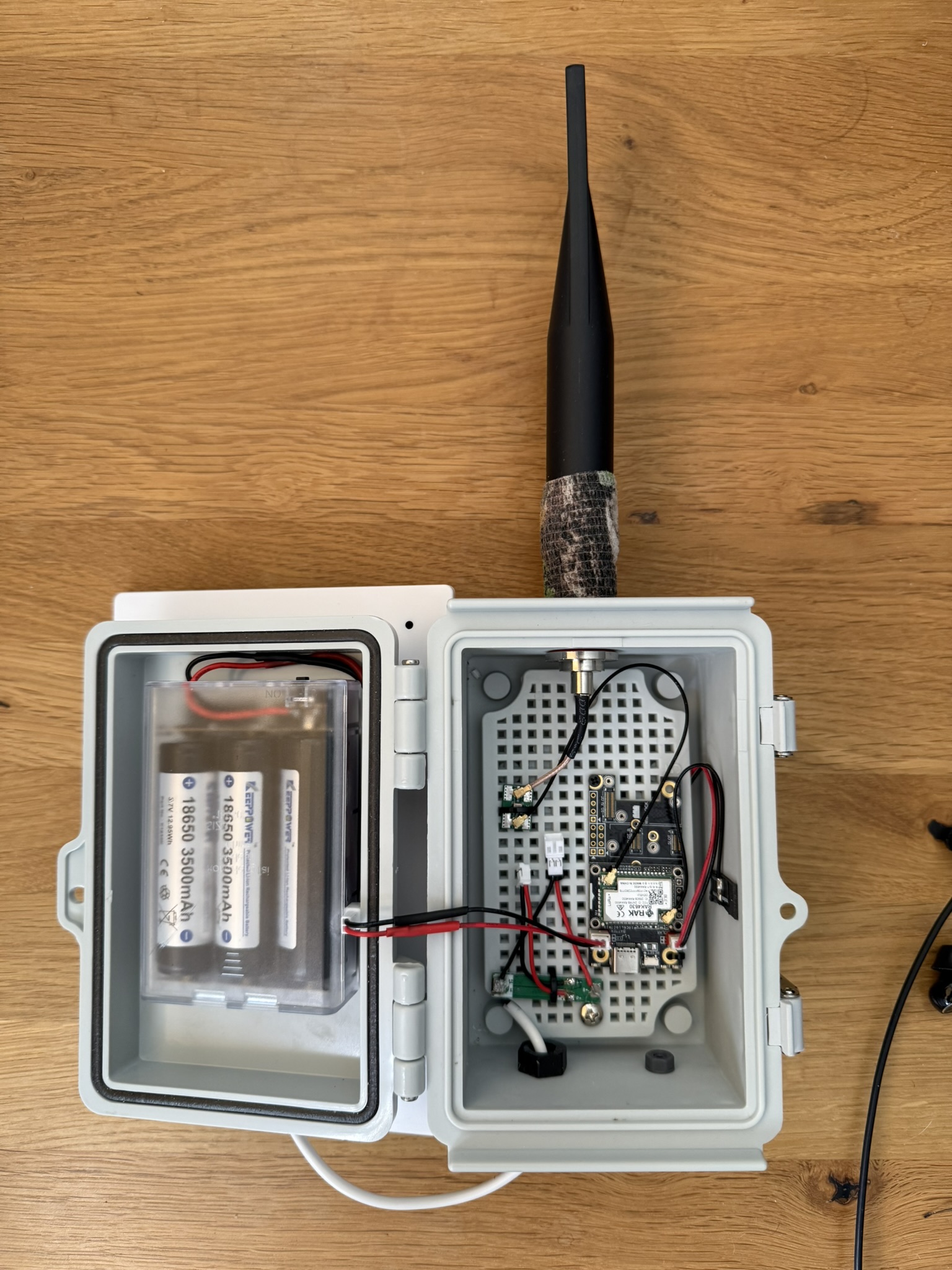
Battery: Keeppower 18650 – 3500 mAh
| Spec | Value |
|---|---|
| Chemistry | Li-Ion |
| Nominal voltage | 3.6 V (max 4.2 V) |
| Capacity | 3500 mAh |
| Protection (PCM) | Over-charge, deep-discharge, short-circuit |
The RAK 19007 charges at roughly 500 mA, well below 1C for this cell — so the PCM protection circuit won’t trigger during normal solar charging. The built-in protection makes it suitable for unattended, long-term outdoor operation.
Note on external BMS: I deliberately have no dedicated external BMS connected in this build. The Keeppower 18650 already carries an integrated PCM circuit covering over-charge, deep-discharge, and short-circuit protection. Adding a second BMS on top would be redundant — the cell is individually protected, and the RAK 19007 charge controller handles the charging side. But a CN3791 MPPT would fit perfectly and add the ability for faster charging.
Battery Holder: 18650 3-Slot Box (No-Weld)
| Spec | Value |
|---|---|
| Compatible cells | 18650 / 21700 |
| Slots | 3 (usable as 1S3P, 2S, 3S or single-cell) |
| Wiring | Pre-wired leads, no spot-welding required |
| Lid | Snap-on with retaining tab |
| Housing | Transparent frosted plastic |
| Source | AliExpress |
A simple, no-weld 18650 holder that keeps the cell securely in place inside the enclosure without any permanent modifications. The snap-on lid prevents the cell from rattling loose under vibration, and the pre-soldered wire leads make swapping cells straightforward if needed. Only one of the three slots is populated in this build — the remaining slots leave room to add capacity later if required.
Antenna: ALFA LoRa 868 MHz 5 dBi
| Spec | Value |
|---|---|
| Manufacturer | ALFA Networks |
| Frequency | 868 MHz (EU ISM) |
| Gain | 5 dBi (omnidirectional, vertically polarised) |
| Vertical beamwidth | ~25–30° |
| Form factor | Outdoor-rated weatherproof stick |
| Connector | N-Male |
| Source | getic.de |
Note on the “HaLow” label: This is purely marketing copy from ALFA. The antenna has no relation to IEEE 802.11ah (Wi-Fi HaLow) — it is a standard 868 MHz LoRa stick antenna. The “HaLow” branding refers to the frequency band aesthetically, nothing more.
Coax: U.FL → N-Female RG178 Pigtail
| Spec | Value |
|---|---|
| Cable type | RG178 |
| Connectors | U.FL (RAK 4631 side) → N-Female (chassis bulkhead) |
| Length | < 20 cm |
| Estimated loss @ 868 MHz | ~0.3–0.5 dB per 30 cm |
| Impedance | 50 Ω |
| Source | AliExpress |
Keeping the pigtail short matters with RG178 — it’s a thin, flexible cable optimised for tight spaces, not long runs. Under 20 cm the insertion loss is negligible. The N-Female bulkhead provides a weatherproof, mechanically robust connection point for the external antenna without putting any stress on the board-level U.FL connector.
Solar Panel: 10 W / 5 V
| Spec | Value |
|---|---|
| Power | 10 W |
| Output voltage | 5 V |
| Original connector | Micro USB (replaced) |
| Modified connector | JST 1.25mm 2-pin |
| Connected to | RAK 19007 solar input (directly to charge controller) |
| Source | AliExpress |
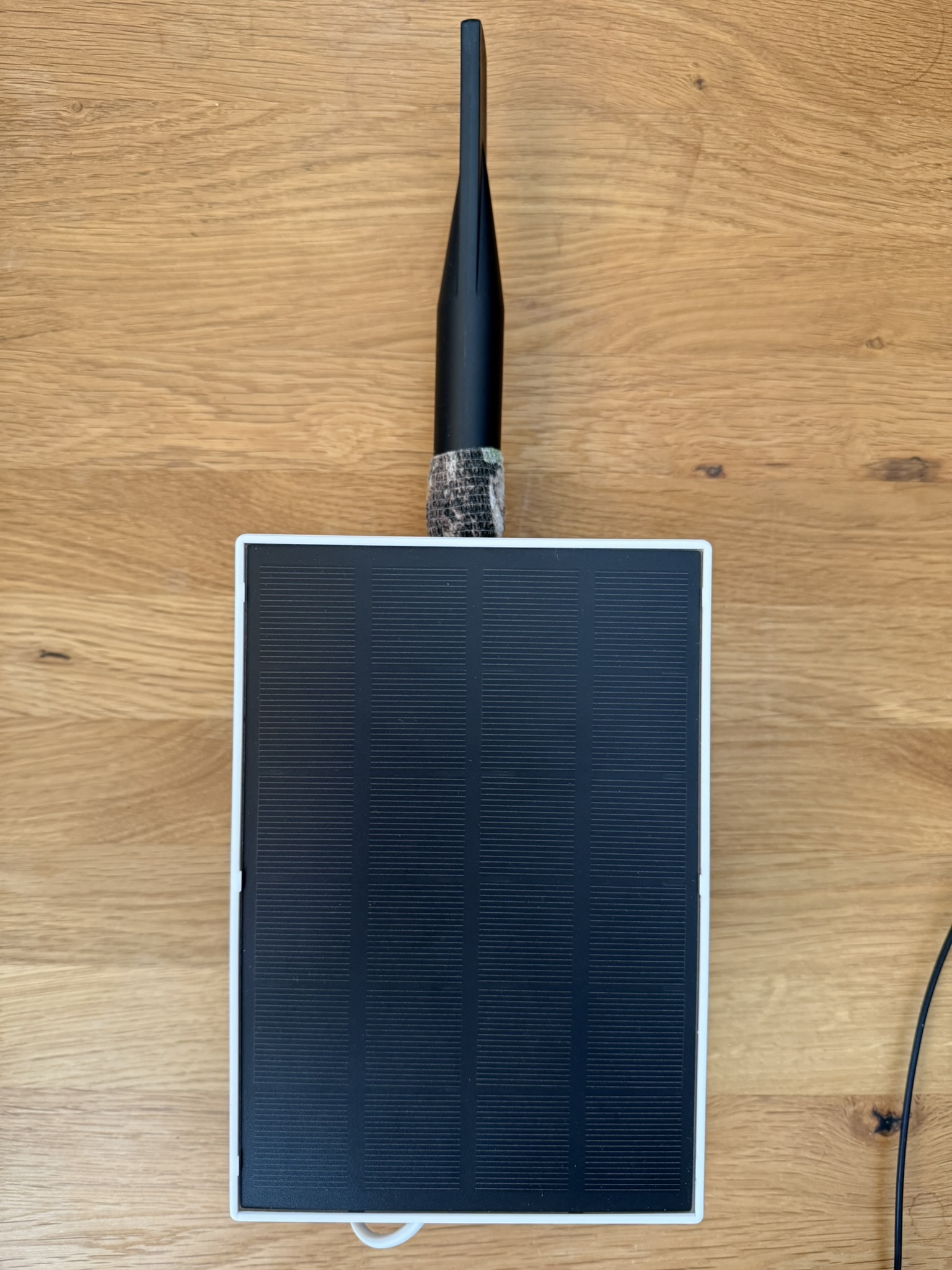
The panel originally shipped with a Micro USB plug, which was removed and replaced with a JST 1.25mm 2-pin connector to match the RAK 19007 solar input directly. This routes power straight to the charge controller — no USB negotiation layer, no additional connector to corrode outdoors.
10 W at 5 V is generously oversized for this build. The nRF52840 + SX1262 stack draws well under 150 mA peak during TX. Even on a grey, cloudy day the panel keeps the cell topped up with headroom to spare.
Enclosure Vent: IP68 Pressure Equalization Valve
| Spec | Value |
|---|---|
| Type | Breathable vent plug (Gore-style membrane) |
| Thread | M12 (this build) — available M5–M20 |
| Rating | IP68 |
| Material | Nylon PA66 |
| Function | Pressure equalisation, moisture exclusion |
| Source | AliExpress |
A sealed outdoor enclosure is subject to significant internal pressure swings as it heats up during the day and cools down at night. Without a vent, repeated pressure cycles will eventually work moisture past the gasket seals — exactly the failure mode you want to avoid in an unattended deployment. The breathable vent plug solves this by allowing air to pass through a hydrophobic membrane that blocks liquid water and dust. IP68-rated, so it doesn’t compromise the enclosure’s overall protection class.
SAW Filter: 869 MHz / 2 MHz Narrowband
| Spec | Value |
|---|---|
| Type | SAW (Surface Acoustic Wave) bandpass filter |
| Center frequency | 869 MHz |
| Bandwidth | 2 MHz (narrowband) |
| Target use | Meshtastic / MeshCore EU868 |
| Placement | Inline between SX1262 and antenna path |
| Source | Elektronik Reich |
The EU868 frequency plan is surrounded by busy spectrum — GSM-900 base stations sit just below 880 MHz, and various ISM devices occupy adjacent bands. A SAW filter at 869 MHz with 2 MHz passband lets through the MeshCore channel (typically 869.525 MHz) while sharply attenuating everything outside that window.
The 2 MHz bandwidth is well matched to the LoRa signal: even at the widest channel setting (500 kHz BW) the signal fits comfortably inside the passband, so there is no in-band distortion. The benefit shows up most in dense urban environments where adjacent-band interference would otherwise desensitise the SX1262 receiver.
Placed inline between the SX1262 RF port and the RG178 pigtail, the filter adds a small insertion loss (typically 1–2 dB for SAW filters in this range) — a worthwhile trade for meaningfully better receive sensitivity under real-world conditions.
RF Chain Summary
For reference, the complete RF path from SoC to air:
| |
Estimated total insertion loss between SoC output and antenna feed point: ~2–3 dB (SAW filter ~1–2 dB + pigtail < 1 dB).
Power Budget (rough)
| State | Current draw |
|---|---|
| Deep Sleep | ~3–5 µA |
| RX (listening) | ~5–7 mA |
| TX @ +22 dBm | ~120 mA (short bursts) |
| Average (repeater duty) | ~10–20 mA |
At an average of ~15 mA and 3500 mAh capacity, the battery alone covers roughly 230 hours of runtime — nearly 10 days without any sun. The 10 W panel makes this effectively indefinite under normal conditions.